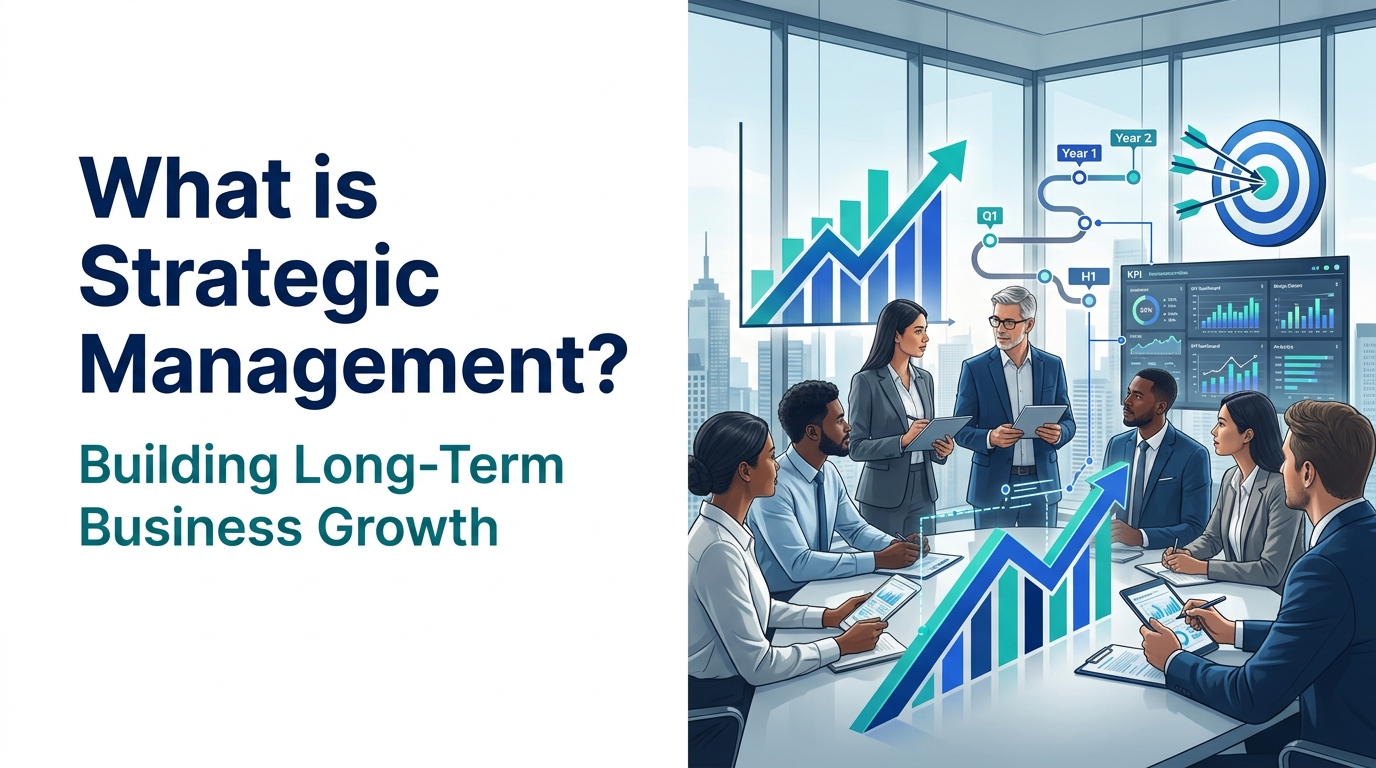
What is Strategic Management? A Complete Guide for Growing Businesses
Learn what strategic management is, its process, benefits, frameworks, and how organizations use it to achieve long-term business growth and success.
What is Strategic Management?
Strategic management is the process of planning, organizing, managing, and utilizing resources to achieve an organization’s long-term goals and objectives.
It helps businesses analyze market conditions, evaluate performance, identify opportunities, and develop strategies that drive sustainable growth. By aligning resources, people, and processes with business objectives, strategic management creates a clear roadmap for success.
At its core, strategic management combines strategic thinking with data-driven decision-making. Organizations often use tools such as SWOT analysis, balanced scorecards, performance metrics, and business intelligence to evaluate progress and improve outcomes.
While senior leadership is responsible for defining the organization’s strategic direction, successful execution requires collaboration across all departments and levels of the business.
Strategic Management Process
Strategic management is not a one-time activity. It is a continuous cycle of planning, execution, evaluation, and improvement.
The process typically involves:
- Defining organizational goals
- Assessing the current business environment
- Developing strategic plans
- Executing initiatives
- Measuring results
- Refining strategies for continuous improvement
Approaches to Strategic Management
Organizations generally adopt one or both of the following approaches:
Prescriptive Approach
The prescriptive approach focuses on designing and developing strategies before implementation.
It helps organizations:
- Set clear objectives
- Prioritize business goals
- Create structured roadmaps
- Allocate resources effectively
This approach is useful when businesses need a clear direction and long-term planning framework.
Descriptive Approach
The descriptive approach focuses on strategy execution and adaptation.
Rather than following a rigid plan, businesses adjust strategies based on real-world challenges, market changes, and operational realities.
This approach emphasizes flexibility and responsiveness.
Successful organizations often combine both approaches—carefully planning strategies while remaining adaptable during execution.
Leadership in Strategic Management
Strategic management is primarily driven by executive leadership and senior management teams.
Their responsibilities include:
- Defining strategic goals
- Communicating business priorities
- Allocating resources
- Monitoring progress
- Driving organizational alignment
Strong leadership encourages employee participation and ownership. When employees understand the strategy and their role in achieving it, collaboration improves and execution becomes more effective.
What Is Involved in Strategic Management?
Strategic management focuses on identifying business challenges, developing solutions, allocating resources, and measuring outcomes.
Organizations commonly use:
- SWOT Analysis
- Balanced Scorecards
- Performance Metrics
- Business Intelligence Tools
- Market Research Data
Strategic management ensures resources such as people, technology, and budgets are directed toward the initiatives that create the greatest business impact.
Benefits of Strategic Management
Financial Benefits
Increased Productivity and Profitability
Clear strategic direction helps employees focus on high-impact activities, improving productivity and operational efficiency.
Greater efficiency often contributes to stronger profitability and sustainable business growth.
Better Risk Management
Organizations with effective strategies are better prepared to navigate market fluctuations, economic uncertainty, and competitive pressures.
Strategic planning improves resilience and enables faster recovery from business challenges.
Non-Financial Benefits
Improved Decision-Making
Data-driven strategies provide leaders with greater confidence when making business decisions.
Enhanced Collaboration
When everyone works toward shared objectives, teams collaborate more effectively and reduce operational silos.
Better Customer Experience
Strategic planning helps organizations improve products, services, and customer interactions.
Greater Organizational Focus
A clearly defined strategy aligns people, resources, and business priorities around common goals.
5 Key Components of Strategic Management
1. Goal Setting
Every successful strategy begins with clear goals.
Organizations should establish measurable objectives and define success indicators.
2. Situation Analysis
Understanding the current business position is essential.
Organizations often conduct SWOT analysis to identify:
- Strengths
- Weaknesses
- Opportunities
- Threats
This evaluation helps identify improvement opportunities and competitive advantages.
3. Strategy Formulation
Based on goals and analysis, organizations create action plans designed to improve performance and support growth.
Effective strategies should be:
- Specific
- Measurable
- Achievable
- Relevant
- Time-bound (SMART)
4. Strategy Execution
Execution transforms plans into measurable outcomes.
Organizations must:
- Communicate objectives clearly
- Assign responsibilities
- Monitor implementation
- Track progress
5. Performance Measurement and Improvement
Results should be regularly reviewed to identify opportunities for optimization.
Continuous improvement helps organizations maintain long-term success and adaptability.
Types of Strategic Management Strategies
Business Strategy
Focuses on long-term growth, profitability, and market positioning.
Corporate Strategy
Guides the overall direction of the organization and determines resource allocation across business units.
Competitive Strategy
Helps organizations create differentiation and gain a competitive advantage.
Innovation Strategy
Focuses on developing new products, services, technologies, and business models.
Operational Strategy
Improves efficiency through optimized processes, systems, and resource utilization.
Popular Strategic Management Frameworks
SWOT Analysis
SWOT Analysis evaluates internal and external factors affecting organizational performance.
It helps businesses identify:
- Strengths
- Weaknesses
- Opportunities
- Threats
The framework supports informed decision-making and sustainable growth planning.
Balanced Scorecard
The Balanced Scorecard measures performance across multiple dimensions—not just financial results.
It evaluates:
- Financial Performance
- Customer Perspective
- Internal Business Processes
- Learning and Growth
This framework helps connect daily operations with long-term strategic objectives.
Strategic Management Example
Consider a company operating in a highly competitive market.
By collecting customer feedback, improving internal processes, investing in technology, and enhancing customer loyalty programs, the organization can strengthen customer relationships and improve business performance.
This reflects a key principle of strategic management:
Organizations that continuously align their strategy with customer needs are better positioned for long-term growth and competitiveness.
Why Strategic Management Matters
In today’s rapidly evolving business environment, operational efficiency alone is not enough.
Strategic management provides:
- Clear direction
- Effective resource allocation
- Operational agility
- Improved performance
- Stronger competitive positioning
Organizations that combine strategic planning with disciplined execution are better equipped to achieve sustainable growth and long-term success.
Frequently Asked Questions (FAQs)
What is strategic management?
Strategic management is the process of planning, implementing, monitoring, and optimizing strategies to achieve organizational goals and long-term business success.
What are the benefits of strategic management?
Strategic management improves decision-making, resource utilization, productivity, competitiveness, and long-term business growth.
What are the key components of strategic management?
The primary components include goal setting, situation analysis, strategy formulation, implementation, performance measurement, and continuous improvement.
Why is strategic management important for businesses?
It helps organizations align resources, employees, and operations with business objectives while improving adaptability and competitiveness.
What is the difference between strategic planning and strategic management?
Strategic planning focuses on creating strategies, whereas strategic management includes planning, execution, monitoring, and continuous improvement.
What tools are commonly used in strategic management?
Popular tools include SWOT Analysis, Balanced Scorecard, Key Performance Indicators (KPIs), Business Intelligence tools, and performance dashboards.
How does strategic management improve organizational performance?
By aligning employee efforts with business goals, improving decision-making, optimizing resource allocation, and encouraging continuous improvement.
What is a SWOT Analysis in strategic management?
SWOT Analysis is a framework used to identify an organization’s strengths, weaknesses, opportunities, and threats to support strategic decision-making.
Who is responsible for strategic management?
Senior leadership typically defines the strategy, while managers and employees across the organization contribute to successful execution.
Can small businesses benefit from strategic management?
Yes. Strategic management helps small businesses prioritize goals, allocate resources efficiently, manage risks, and scale sustainably.
Similar blogs you may like